
 English
 Español
 Français
 Deutsch
 日本語
日本語 العربية
 Türk dili
 Indonesia
 中文
中文
3D Printing Filaments
3D printing filaments are the materials used by most desktop and industrial fused deposition modeling printers to create physical objects layer by layer. They are typically supplied as long, evenly wound strands that melt inside the printer’s hot end and are deposited through a nozzle according to a digital model. The choice of filament has a major effect on print quality, strength, flexibility, surface finish, and the overall usability of the final part.One of the most common filament types is PLA, or polylactic acid. PLA is widely used because it is easy to print, has low warping, and produces smooth results with relatively little odor. It is suitable for beginners, prototyping, decorative items, and models that do not need to withstand high temperatures. Another popular option is ABS, which is known for better heat resistance and impact strength than PLA. However, ABS can be more difficult to print because it may warp or crack if the printing environment is not controlled.PETG is another important filament. It combines many of the easy-printing qualities of PLA with improved toughness and better resistance to moisture and chemicals. For this reason, PETG is often used for functional parts, containers, mechanical components, and items that need moderate durability. TPU and other flexible filaments are designed to bend and stretch rather than break. These materials are useful for phone cases, seals, grips, wearables, and parts that need elasticity.Beyond the standard materials, there are many specialty filaments. Nylon offers excellent wear resistance and toughness, making it useful for gears, hinges, and engineering parts. Polycarbonate provides high strength and heat resistance, but it usually requires high printing temperatures and careful handling. Composite filaments may include additives such as carbon fiber, glass fiber, wood, metal powder, or glow-in-the-dark particles. These blends can improve rigidity, appearance, or specific physical properties, though they may also require hardened nozzles or special settings.When selecting a filament, several factors should be considered. Printing temperature, bed adhesion, shrinkage, flexibility, strength, and moisture sensitivity all matter. Some filaments absorb water from the air and must be stored in sealed containers or dried before use. The diameter is also important, with 1.75 mm and 2.85 mm being the most common sizes. Consistent diameter helps maintain reliable extrusion and accurate printing.Color and surface finish are also important for both artistic and practical projects. Filaments are available in many colors, translucent styles, matte finishes, glossy finishes, and even textured varieties. This allows users to choose materials not only for performance but also for appearance. In some applications, filament choice determines whether a print is merely a visual prototype or a durable functional part.In summary, 3D printing filaments are the foundation of material-based additive manufacturing. Each type offers a different balance of ease of use, strength, flexibility, and appearance. Understanding the properties of each filament helps users achieve better printing results and choose the right material for each project.
продукт
-
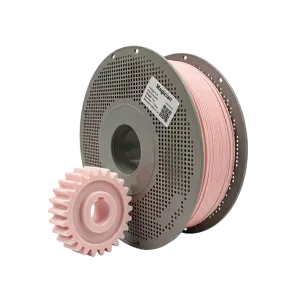
ABS Filaments
Их классификация: ABS & ASAмнения: 45номер: 1.75mmВремя выпуска: 2026-10-09 19:10:58●Low Warping & Crack Resistant Specially formulated to solve traditional ABS issues—delivering significantly reduced shrinkage and improved layer adhesion to prevent edge warping and cracking. ●High Strength & Thermal Resistance Retains the classic mechanical durability, impact strength, and heat resistance of ABS, making it ideal for high-stress functional parts and engineering prototypes. ●Easier Printing & Low Odor Engineered for lower printing temperatures and minimal odor output, offering a smoother, safer, and much hassle-free printing experience. ●Precision & Fine Detail Excellent dimensional stability allows for stable, high-precision printing across both intricate designs and large structural models. ●Nearly 4 Vibrant Colors Choose from close to 4 rich color options to meet diverse prototyping and end-use part requirements.
новости
классификация:
-
[Application Cases]Shanghai Janton’s “Princess Series” 3D Printing Filaments Ma...
2026-10-09 18:23:59
случай
классификация:
Нет результатов поиска!
видео
классификация:
Нет результатов поиска!
скачать
классификация:
Нет результатов поиска!
вербовка
классификация:
Нет результатов поиска!
Рекомендуемые продукты
Нет результатов поиска!



 телефон